
Communication
Communication in hospitality means transmitting information clearly, professionally and warmly whether to a guest or a teammate.
PILLAR
MEANING
EXAMPLE IN ACTION
Clarity
Speak simply and understandably
“Your table will be ready in 5 minutes.”
Courtesy
Be polite and respectful in every interaction
“May I assist you with your luggage?”
Confidence
Deliver information calmly and with certainty
“Yes, the chef can adapt that to be gluten-free.”
Consistency
Communication the same way across shifts & staff levels
Every team member greets guests with a smile.
Why it matters?
Sets the tone for the guest experience.
Creates trust and emotional comfort.
Improves team coordination (especially during busy service).
Drives positive reviews and tips.
In hospitality your voice is your brand. Guests won’t always remember the food or the decor but they will remember how they were spoken to.
✅ DOs
Speak clearly and slowly
Use Warm, positive language
Confirm and repeat orders/info
Use names when possible
❌ DON’Ts
Mumble or speak too fast
Use negative or closed phrases
Assume or guess what guests want
Be impersonal or robotic
SITUATION
NEGATIVE PHRASE
POSITIVE ALTERNATIVE
Dish unavailable
“We don’t have that.”
“That dish is currently unavailable, but I recommend…”
Delay in service
“It’s late.”
“Thank you for your patience, your order is on its way.”
Guest asks a tricky question
“I don’t know.”
“Let me find that out for you right away.”
Key phrases to practice
❌ DON’Ts
No problem
Unfortunately
You have to…
I’ll try
Yep
Ok
At wait / two seconds
What do you want?
I put you on hold
It’s over there
Are you ready to order?
Would you like a drink?
Is everything ok?
Please calm down
That’s not my job
I am busy right now
Good afternoon/evening
✅ DOs
My pleasure. Absolutely. Of course
I regret that I am unable to do so, as an alternative…
May I suggest…
Let me address that for you
Yes
Excellent. Perfect
Allow me a short moment…
How may I assist you?
May I put you on a brief hold, please?
Allow me to guide you. This way please
Can I help you making a decision?
What do you care for?
Do you need anything else at the moment?
I apologise, thank you for letting me know
Let me get… so we can best address your needs
Alle me a short moment
Good afternoon/evening Sir/Madame
Non-verbal communication includes your body language, facial expression, posture, gesture, eye contact and even your uniform. Guests often feel your mood and attitude before you even speak.
NON-VERBAL COMMUNICATION
WHY IT MATTERS
TIPS
Eye contact
Builds trust and shows attention
Look at the guest when speaking or listening.
Smiling
Signals warmth and openness
Smile naturally, not forced even on busy days.
Posture
Reflects confidence and readiness to help
Stand upright, no hands in pockets or crossed arms.
Gestures
Emphasize intereste and clarity
Use open, calm hand movements – avoid pointing.
Personal appearance
Sends a message of profesionalism
Neat uniform, clean hands, tidy hair, name badge visible.
POS System
Team communication
Clear messages and respect
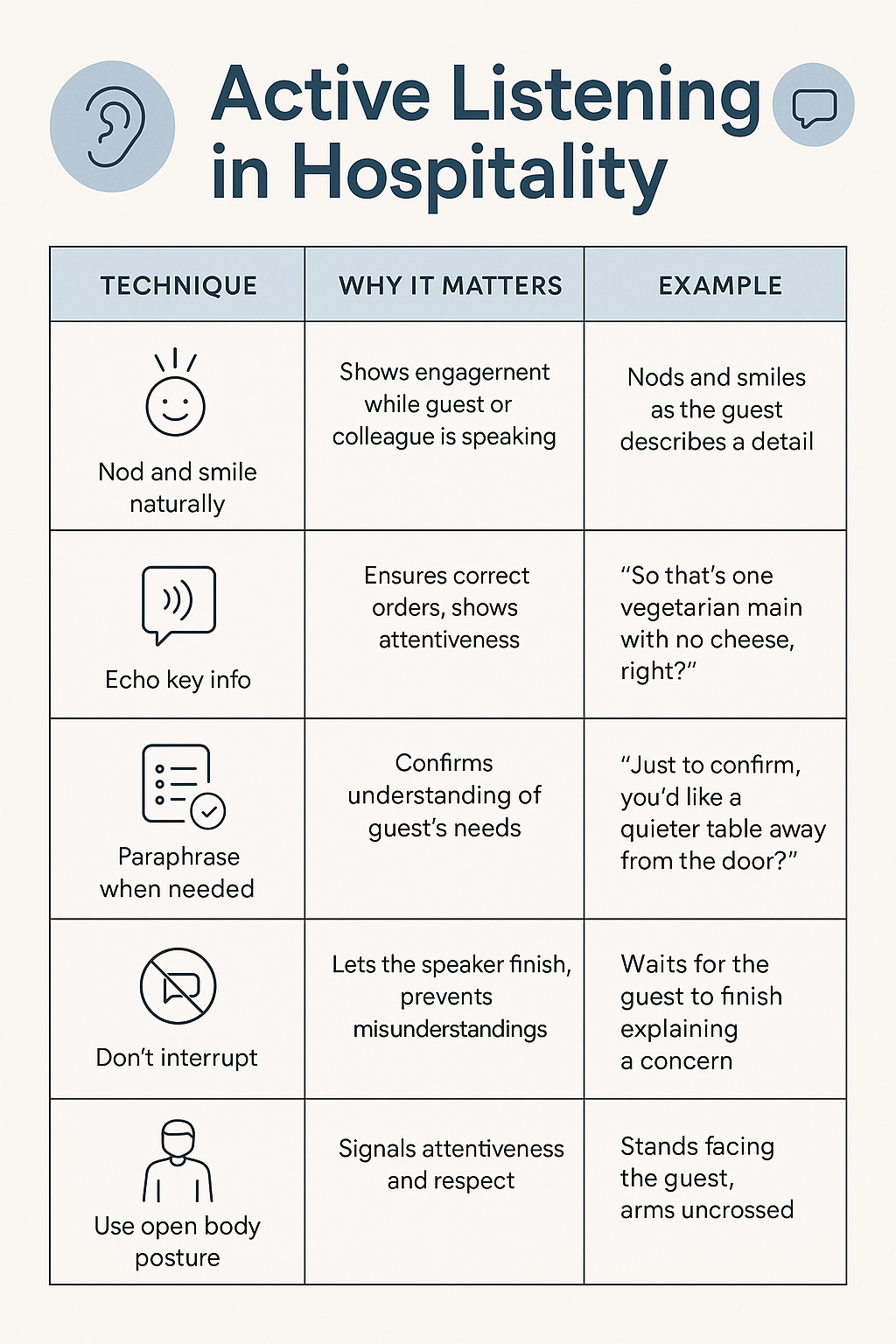
Active listening means fully focusing on the speaker, not just hearing words, but understanding the intention and emotion behind them.
📣 Specific situations to pratice
- A guest explaining allergies.
→ Repeat back the restrictions, confirm with the kitchen, and reassure with clarity.
- A coworker giving a handover.
→ Ask clarifying questions, take notes if needed, and avoid distractions.
- A guest making a complaint.
→ Let them finish, acknowledge the emotion, and summarise their concern before reacting.
In hospitality, great guest service depends, on how well the front, kitchen, and back teams communicate. Internal communication avoids confusion, delays, and errors – especially during service.
Main objectives
- Ensure clear, quick and accurate messages between departments.
- Avoid misunderstandings during handover or rush hours.
- Build a respectful and professional tone in daily interactions.
PRINCIPLE
EXEMPLE
Be specific
“Table 12 wants no sauce” ❌ => Table 12: duck, no red wine sauce” ✅
Use names
“Chef Marco, Table 5 has a vegan request”
Confirm information
“Heard: one no-gluten free. Correct?”
Keep it calm under pressure
Avoid shouting or rushing – clarity first
Follow up important info
If urgent, repeat and write it down.
Shift Handover Checklist Examples
- Guest requests?
- Special dietary restrictions?
- VIPs or event expected?
- Feedback or complaints?
- 86’s, stock shortage?
The L.E.A.R.N. Method.
STEP
WHAT YOU DO
WHAT YOU SAY
Listen
Let them talk, don’t interrup
“Please tell me what happened.”
Empathise
Show you understand their emotion
“I totally understand why you are upset.”
Apologize
Say sorry sincerely
“I am really sorry for what happened.”
React
Offer a solution fast
“Would you like a replacement of your dish?”
Notify
Tell your manager
“I’ll make sure my manager is aware.”
In hospitality, you are welcoming people from all over the world, with different customs, expectations and comfort zone. Being aware of this builds trust, avoid awkward moments and makes every guest feel at home.
Language tips
- Speak clearly and calmly (accent)
- Repeat or rephrase if needed
- Use visual aids or menus
- Smile and use positive body language
- Understand the pillars of hospitality communication
- Apply clarity, courtesy, confidence, and consistency
- Use positive and professional language with guests
- Master non-verbal communication and body language
- Actively listen to both guests and colleagues
- Communicate efficiently and respectfully with the kitchen
- Handle guest complaints using the L.E.A.R.N method
Communication is a skill that you can learn. It’s like riding a bicycle or typing. If you’re willing to work at it, you can rapidly improve the quality of every part of your life.
- Understand the pillars of hospitality communication
- Apply clarity, courtesy, confidence, and consistency
- Use positive and professional language with guests
- Master non-verbal communication and body language
- Actively listen to both guests and colleagues
- Communicate efficiently and respectfully with the kitchen
- Handle guest complaints using the L.E.A.R.N method
Communication is a skill that you can learn. It’s like riding a bicycle or typing. If you’re willing to work at it, you can rapidly improve the quality of every part of your life.
Hospitality communication
Communication in hospitality means transmitting information clearly, professionally and warmly whether to a guest or a teammate.
Pillar: Clarity
Meaning: Speak simply and understandably
Example in Action: “Your table will be ready in 5 minutes.”
Pillar: Courtesy
Meaning: Be polite and respectful in every interaction
Example in Action: “May I assist you with your luggage?”
Pillar: Confidence
Meaning: Deliver information calmly and with certainty
Example in Action: “Yes, the chef can adapt that to be gluten-free.”
Pillar: Consistency
Meaning: Communication the same way across shifts & staff levels
Example in Action: Every team member greets guests with a smile.
Why it matters?
- Sets the tone for the guest experience.
- Creates trust and emotional comfort.
- Improves team coordination (especially during busy service).
Verbal communication
In hospitality your voice is your brand. Guests won’t always remember the food or the decor but they will remember how they were spoken to.
✅ DOs
Speak clearly and slowly
Use Warm, positive language
Confirm and repeat orders/info
Use names when possible
❌ DON’Ts
Mumble or speak too fast
Use negative or closed phrases
Assume or guess what guests want
Be impersonal or robotic
Situation: Dish unavailable
Negative Phrase: “We don’t have that.”
Positive Alternative: “That dish is currently unavailable, but I recommend...”
Situation: Delay in service
Negative Phrase: “It’s late.”
Positive Alternative: “Thank you for your patience, your order is on its way.”
Situation: Guest asks a tricky question
Negative Phrase: “I don’t know.”
Positive Alternative: “Let me find that out for you right away.”
Key phrases to practice
❌ DON’T: No problem
✅ DO: My pleasure. Absolutely. Of course
❌ DON’T: Unfortunately
✅ DO: I regret that I am unable to do so, as an alternative...
❌ DON’T: You have to...
✅ DO: May I suggest...
❌ DON’T: I’ll try
✅ DO: Let me address that for you
❌ DON’T: Yep
✅ DO: Yes
❌ DON’T: Ok
✅ DO: Excellent. Perfect
❌ DON’T: At wait / two seconds
✅ DO: Allow me a short moment...
❌ DON’T: What do you want?
✅ DO: How may I assist you?
❌ DON’T: I put you on hold
✅ DO: May I put you on a brief hold, please?
❌ DON’T: It’s over there
✅ DO: Allow me to guide you. This way please
❌ DON’T: Are you ready to order?
✅ DO: Can I help you making a decision?
❌ DON’T: Would you like a drink?
✅ DO: What do you care for?
❌ DON’T: Is everything ok?
✅ DO: Do you need anything else at the moment?
❌ DON’T: Please calm down
✅ DO: I apologise, thank you for letting me know
❌ DON’T: That’s not my job
✅ DO: Let me get... so we can best address your needs
❌ DON’T: I am busy right now
✅ DO: Allow me a short moment
❌ DON’T: Good afternoon/evening
✅ DO: Good afternoon/evening Sir/Madame
Non-verbal communication
Non-verbal communication includes your body language, facial expression, posture, gesture, eye contact and even your uniform. Guests often feel your mood and attitude before you even speak.
Non-Verbal: Eye contact
Why it Matters: Builds trust and shows attention
Tips: Look at the guest when speaking or listening.
Non-Verbal: Smiling
Why it Matters: Signals warmth and openness
Tips: Smile naturally, not forced even on busy days.
Non-Verbal: Posture
Why it Matters: Reflects confidence and readiness to help
Tips: Stand upright, no hands in pockets or crossed arms.
Non-Verbal: Gestures
Why it Matters: Emphasize interest and clarity
Tips: Use open, calm hand movements – avoid pointing.
Non-Verbal: Personal appearance
Why it Matters: Sends a message of professionalism
Tips: Neat uniform, clean hands, tidy hair, name badge visible.
Non-Verbal: POS System
Why it Matters: Team communication
Tips: Clear messages and respect
Active listening
Active listening means fully focusing on the speaker, not just hearing words, but understanding the intention and emotion behind them.
📣 Specific situations to pratice
- A guest explaining allergies.
- A coworker giving a handover.
- A guest making a complaint.
Internal communication
In hospitality, great guest service depends, on how well the front, kitchen, and back teams communicate. Internal communication avoids confusion, delays, and errors – especially during service.
Main objectives
- Ensure clear, quick and accurate messages between departments.
- Avoid misunderstandings during handover or rush hours.
- Build a respectful and professional tone in daily interactions.
Principle: Be specific
Example: “Table 12 wants no sauce” ❌ → “Table 12: duck, no red wine sauce” ✅
Principle: Use names
Example: “Chef Marco, Table 5 has a vegan request”
Principle: Confirm information
Example: “Heard: one no-gluten free. Correct?”
Principle: Keep it calm under pressure
Example: Avoid shouting or rushing – clarity first
Principle: Follow up important info
Example: If urgent, repeat and write it down.
Shift Handover Checklist Examples
- Guest requests?
- Special dietary restrictions?
- VIPs or event expected?
- Feedback or complaints?
- 86’s, stock shortage?
Conflict & complaint handling
The L.E.A.R.N. Method.
Step: Listen
What You Do: Let them talk, don’t interrupt
What You Say: “Please tell me what happened.”
Step: Empathise
What You Do: Show you understand their emotion
What You Say: “I totally understand why you are upset.”
Step: Apologize
What You Do: Say sorry sincerely
What You Say: “I am really sorry for what happened.”
Step: React
What You Do: Offer a solution fast
What You Say: “Would you like a replacement of your dish?”
Step: Notify
What You Do: Tell your manager
What You Say: “I’ll make sure my manager is aware.”
Cultural sensitivity & language awareness
In hospitality, you are welcoming people from all over the world, with different customs, expectations and comfort zone. Being aware of this builds trust, avoid awkward moments and makes every guest feel at home.
Language tips
- Speak clearly and calmly
- Repeat or rephrase if needed
- Use visual aids or menus
- Smile and use positive body language